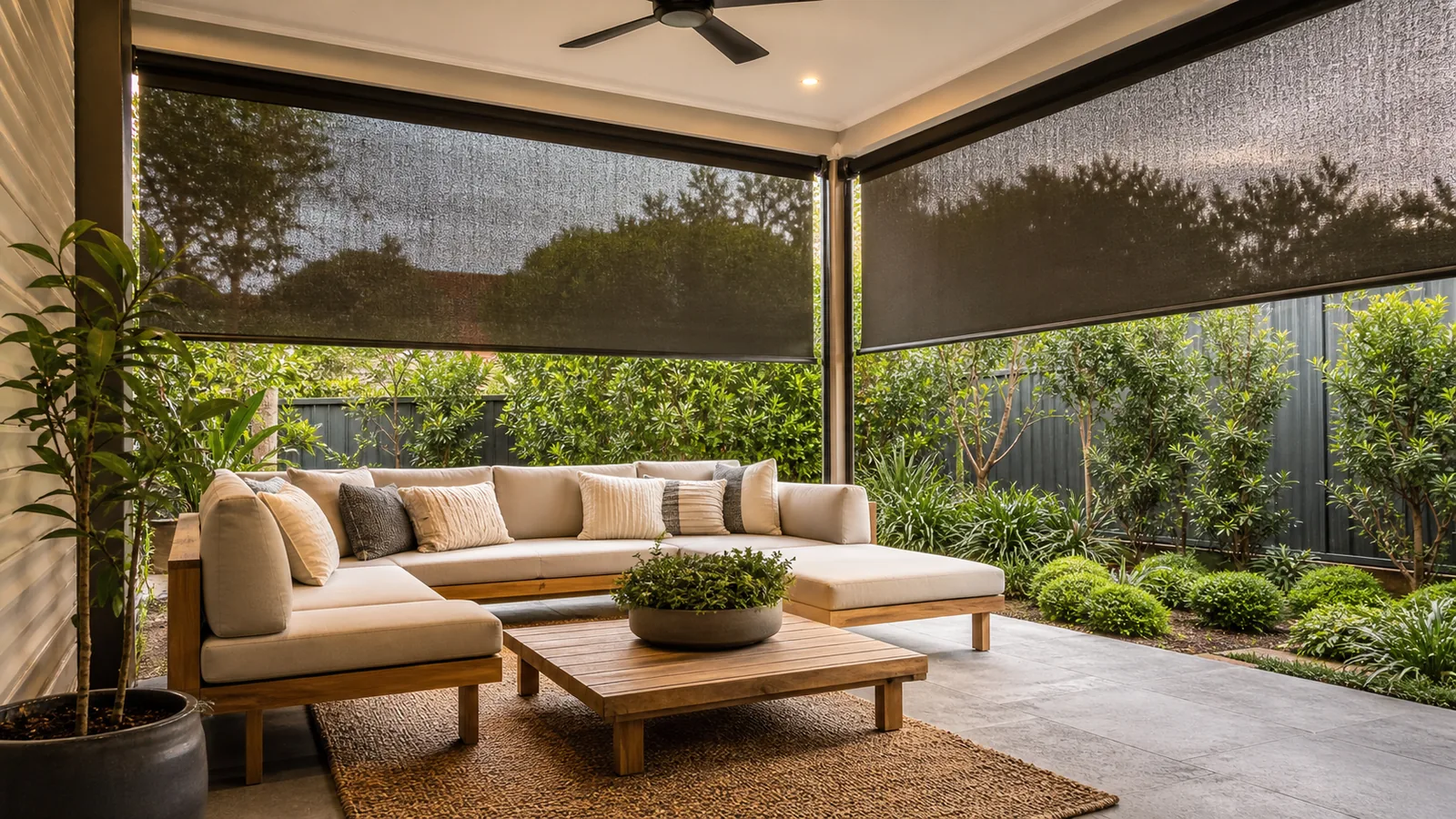
Define exactly what should disappear from view
Privacy is easier to specify when you name the view you want to interrupt. Is a neighbour looking directly at the dining table, can people on the footpath see into the living room through the patio, or does an upstairs window overlook the whole seating area? Draw the observer's position as well as your own. A screen that works for someone standing in the garden may leave a clear line of sight from above. Take photographs from places you can lawfully access, and mark the sensitive area rather than asking for complete privacy across every opening.
In a Cairns home, outdoor living often connects directly to the kitchen or lounge. The privacy brief should include those rooms when their doors are open. Sit in your usual chair and ask another household member to move around the public side of the opening. Notice whether the concern is recognising faces, seeing movement, reading a screen or simply feeling on display. Those are different expectations. A supplier can discuss them more usefully than a general request for the darkest blind. Keep the description short enough to attach to the quote and refer to it when checking samples.
Test samples under your evening lighting
Do the sample test with the lighting you actually use for dinner. Turn on the pendant, outdoor downlights and nearby room lights, then look from both sides of the proposed blind line. Use a sample large enough to assess a face or a seated person's outline, rather than relying on a tiny square held against a window. Ask the supplier for a larger sample or a suitable demonstration if the available swatch is too small. Do not settle the decision from a product photograph taken in daylight, when your main concern starts after sunset.
Ziptrak's fabric guidance distinguishes outgoing visibility and daytime privacy when discussing dark colours. Daytime performance should not be read as a promise of privacy under your night lighting. Record the sample code, its orientation and which lights were on during your own test. If you later change to a brighter fitting over the table, repeat the observation before assuming the same result. What matters is whether the chosen fabric and lighting combination provides the degree of screening you need at the actual opening.
Keep airflow as a separate requirement
A common mistake is to describe privacy as the only objective, then discover that the preferred screen makes the patio feel too enclosed. Tell the supplier which direction you like to leave open and where people sit. Try the sample with the existing ceiling fan running if that is your normal evening arrangement. A fabric sample cannot reproduce the airflow of a completed enclosure, but it helps you identify whether you are heading towards a light screen or a more closed boundary. Ask the supplier to explain that trade-off without promising a particular temperature change.
Consider whether only the neighbour-facing opening needs the privacy treatment. On an Edge Hill verandah, for example, the side towards the adjacent home may matter more than the garden frontage. Different treatments on different sides can be deliberate rather than untidy if the frame colour and layout are coordinated. Keep a clear route for fresh air and for people moving between the house and garden. If privacy requires closing every side, discuss whether you really want a blind enclosure or a different room arrangement. A shaded outdoor area and a closed indoor room are different design briefs.
Check angled views and perimeter gaps
Look along the edge of the sample as well as through its centre. A gap between a guide and a post, above a housing or beneath a bottom bar can reveal more than the fabric itself. Ask the supplier to show where these junctions will sit on the finished opening. If the patio floor slopes or has a step, have the bottom detail drawn across that shape. Avoid assuming a neat straight line in a brochure means a matching detail can be achieved on every surface without additional work.
An upstairs viewpoint deserves its own sketch. A blind stopping below the roof line may screen a horizontal view while leaving an angled view through the upper opening. Conversely, screening high above seated eye level may be enough to interrupt a particular sightline while leaving lower garden views open. Work through this with a temporary, safely positioned sample or a drawing rather than fixing makeshift sheets overhead. The purpose is to find the smallest useful intervention. A full opaque wall around the patio is not automatically the best response to one awkward viewing angle.
Decide what you can accept losing
Make a list of the views you want to keep before choosing an opaque treatment. You might value seeing children in the garden, noticing a visitor at the gate or watching a pet near the back door. Test those exact views from the normal seat with the sample held at the proposed blind line. If a dense material removes a view you rely on, discuss an independently operated section or a different seating position. Privacy should not be assessed solely from outside; the inside experience is the one you will live with every day.
Also look back through the patio from the kitchen during daylight. A blind chosen for evening privacy may change the feel of the adjoining room when it remains down. Ask whether you are willing to raise it every morning and lower it when required. That routine sounds minor until furniture makes access awkward or several drops need individual attention. Select operation to support the routine you actually intend to follow. The existing manual and motorised guide covers that separate decision without assuming a motor is necessary for every opening.
Use furniture and lighting to refine the brief
Before committing to a blind across the full frontage, experiment with the dining table and the direction of the lights. Moving a chair away from a direct sightline may reduce the amount of screening needed. A light aimed at a wall or the tabletop gives a different visual arrangement from one pointing out towards the garden. Have any permanent electrical changes handled appropriately; the first step is simply observing the existing fittings and trying normal switch combinations. Keep safe circulation space around chairs, doors and the route back into the house.
A practical exercise is to host an ordinary meal with the proposed sample in place and note the moments that still feel exposed. Perhaps the problem is standing at the barbecue rather than sitting at dinner, or the neighbour's view becomes relevant only when the interior sliding door is open. That observation can change the required width or location of the screen. It also avoids choosing a heavy treatment because a short showroom demonstration felt reassuring. Write down the activities, not just the appearance, so the installer understands the reason for each proposed drop.
Make mixed fabrics look intentional
If you choose different materials for privacy and outlook, review them together in the same light. Similar colour names from different ranges may not look alike. Ask for the frame finish, bottom-bar finish and fabric samples to be presented as one set. Place them against the actual posts and nearby doors rather than against a white sample board alone. On a patio with pale tiles or reflective walls, pay particular attention to the way the whole enclosure looks from inside the house. You are choosing a room boundary as well as a product.
Think through what the frontage looks like when one drop is raised and its neighbour is down. Independent operation is useful, but the join should align with something sensible such as an existing post or a clear change of activity. If you later add another blind, a record of the original fabric and finish will help, although future availability still needs checking. Ask the supplier to identify the trade-off between matching the existing system and selecting a fabric that genuinely meets the new privacy need. Exact visual matching should not silently replace the main purpose of the work.
Consider privacy while the blind moves
Ask how the opening looks during the transition between fully raised and fully lowered. You may normally lower a blind after turning on the patio lights, which means the room is briefly visible before the screen reaches its intended position. If that matters to you, decide on a routine that works with the control location. Also consider whether someone outside can reach the control or lift a manual blind from the other side. Explain the privacy requirement to the supplier without assuming a shade product provides security. Screening a view and restricting access are separate requirements and should be specified separately.
Write an acceptance check you can repeat
Include your privacy test in the purchase discussion. Describe where the observer stands, which lights are on and what should no longer be clearly visible. Ask the supplier what they can reasonably confirm for that situation. Avoid a vague guarantee of total privacy if the opening remains partly open or uses see-through fabric. A repeatable check gives you a practical way to assess the finished installation and identify whether a concern comes from fabric selection, a perimeter gap or an unaddressed viewing angle.
At handover, repeat the check before moving furniture back into its final position. Test every normal operating position, including a partially raised blind if that is how you expect to use it. Save the fabric label and a photograph of the completed edge details with your order records. If the result differs from the agreed brief, show the particular sightline and lighting condition rather than simply saying the patio feels wrong. That makes the discussion more specific and gives the supplier a clearer route to investigate the issue.
For a Trinity Beach balcony or a shared residential setting, also establish who can authorise the proposed external appearance before ordering. Obtain the relevant property-specific advice rather than relying on a neighbour having similar blinds. Keep any approval discussion separate from the privacy sample test: permission to install a product does not establish that its fabric solves your problem. The useful outcome is a documented layout that you are allowed to install, can comfortably operate, and have assessed under the evening conditions that prompted the enquiry.
Your discussion checklist
Tick the details you have checked. The remaining items become your questions for the supplier. This list stays in your browser and is not submitted.
All listed details are worth discussing before ordering.
Questions answered
Can I judge privacy from a phone photograph?
Use photographs to explain sightlines, but assess the sample in person too. Camera exposure and screen brightness can change how visible people appear.
Will tint alone give complete privacy?
Do not assume it will. Test the actual material with the intended lighting and ask the supplier to state its limitations.
What if I only need privacy when visitors stay?
Consider independent operation on the affected opening. Explain how often it will be used and where the controls must be reachable.
Discuss the opening you actually use
Tell us where the view into your patio comes from and when privacy matters. Ask to compare fabric samples under your own evening lighting.
Call about your blinds Send opening details